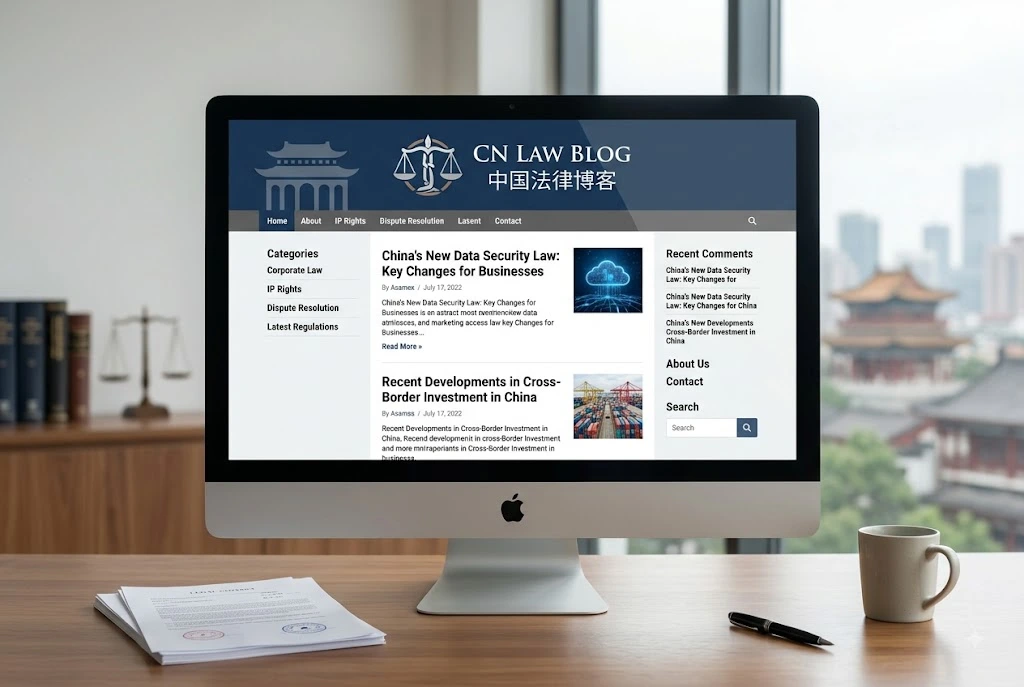
CN Law Blog explains in plain terms what it actually covers, who’s behind it, how it compares to other China law resources, and how to use it without getting burned.
Table of Contents
Introduction
If you’ve typed “CN Law Blog” into a search bar, you’ve probably landed on two different things without realizing it. One is the well-established China Law Blog, running since 2006 out of the law firm Harris Sliwoski (it went by Harris & Moure, then Harris Bricken, before that). The other is a newer crop of sites using a similar short name, sometimes without listing who actually wrote the post. Mixing the two up matters, because one is a decade-plus record built by practicing lawyers, and the other might just be content written to rank. This piece sorts out both, and tells you what to actually do with either.
Where This Blog Came From
Dan Harris and Steve Dickinson started the blog in 2006, back when law firm blogging barely existed as a category. Dickinson had already been working in Asia since 1984. Harris has said the whole thing started at lunch with a friend who wasn’t a lawyer, talking through mistakes he’d watched American companies make going into China. That’s still roughly the tone of the blog today: less legal theory, more “here’s what actually happens when this goes wrong.”
The blog got picked up by the ABA Journal’s Blawg 100 four years running (2007 through 2010), and in 2013 it was added to the Blawg Hall of Fame, a list that, at the time, had only about 20 blogs on it total. According to its founders, it has never taken advertising or sponsorship money from anyone outside the firm. That’s not nothing in a space where a lot of “China business” content is quietly paid for by service providers trying to sell you incorporation packages.
Who Writes It Now
It’s not a one-person operation anymore. Posts now come from a rotating group of Harris Sliwoski attorneys, including Fred Rocafort, Jonathan Bench, Adams Lee, and Grace Yang, alongside Harris and Dickinson. The firm itself has grown well past its Seattle roots too, with offices now spread across Portland, Los Angeles, Phoenix, New York, Salt Lake City, Beijing, Barcelona, Madrid, Palma de Mallorca, and Lisbon.
What Topics It Actually Covers
The bulk of the content sits in a handful of buckets: setting up a legal presence in China (WFOEs, subsidiaries, rep offices, joint ventures), drafting contracts for manufacturing and distribution deals, protecting intellectual property, handling employment and termination issues under Chinese labor rules, and cross-border dispute resolution, including how foreign judgments actually get enforced (or don’t) in Chinese courts.
Two Recent Examples Worth Knowing About
China’s revised Anti-Unfair Competition Law took effect October 15, 2025. It’s described as the biggest overhaul of Chinese market regulation in close to a decade, and one of the changes is new personal liability exposure for executives, not just companies. Separately, China adopted a revised Trademark Law on June 26, 2026, which takes effect January 1, 2027. Foreign companies have roughly a year to adjust before that deadline lands, and most of the commentary so far has focused on the statutory language rather than what businesses need to do differently before the clock runs out.
The blog also covers Sinosure claims (Chinese export credit insurance disputes). One post notes the firm has handled more than 100 of these matters, and says Sinosure has never once reduced the amount it initially demanded, not by a dollar. That’s the kind of specific, unglamorous detail that separates a blog written by people doing the actual work from one written to fill a content calendar.
Common Mistakes People Make Reading a Blog Like This
Treating a blog post as legal advice for their specific situation. A post about WFOEs in general is not the same as advice about your WFOE, your industry, and your province.
Skipping the publish date. Chinese business law moves fast. A post from 2019 about trademark procedure may not reflect the rules that took effect in 2025 or 2026.
Reading one source and assuming that’s the whole picture. Even the blog’s own authors say their goal is to help you understand what generally works, not to lay out legal theory from every angle.
Not checking who actually wrote the post. Some sites using a similar name to “China Law Blog” don’t name individual authors at all, which makes it hard to know if you’re reading a lawyer’s take or a paid content writer’s summary of one.
What Happens If You Skip This Kind of Research
The clearest example is trademark registration. China runs on a first-to-file system, not first-to-use. Whoever files the application first generally owns the mark inside China, regardless of how long you’ve used it elsewhere or how well known your brand already is. Apple learned this the expensive way with the iPad name in China, when a company called Proview had registered it years earlier. Apple ended up paying $60 million to settle and use its own product name. Smaller companies without Apple’s resources often end up rebranding entirely instead.
The blog also covers a pattern it calls the Hong Kong intermediary trap: foreign buyers dealing with a middleman in Hong Kong who looks legitimate (good English, familiar-looking invoices, a real bank account) but isn’t actually the factory making the goods. When something goes wrong, there’s no real party on the other end to hold accountable. The recurring point across most of these posts is that these problems are described as preventable and not new, meaning the same mistakes keep repeating because people skip the research stage.
CN Law Blog vs. Other China Law Resources
Resource
Best for
What it’s not
China Law Blog (Harris Sliwoski)
Practical business law, contracts, IP, disputes, written by practicing lawyers, near-daily posts
Not a source for the actual statutory text
China Law Translate
Reading the real, translated text of Chinese laws and regulations
Broad Asia business news, tax and accounting angle
Less legal depth than a law-firm-run blog
Other “CNLawBlog” style sites
A plain-English starting point for beginners
Often no named author, so harder to verify who’s behind the advice
None of these fully replace the others. A serious reader usually ends up checking two or three of them against each other before making a decision that costs real money.
How to Actually Use a Resource Like This
Read it for patterns, not a script. If three posts describe the same kind of contract dispute playing out the same way, that’s worth paying attention to. Check the date on anything referencing a specific law or deadline, since China’s rules change often enough that a two-year-old post can be outdated. Cross-check anything statutory against a primary source like China Law Translate. And before you register anything, sign anything, or wire money to anyone, talk to a lawyer who is actually licensed to handle China-related matters, not just someone who read the same blog you did.
FAQs
Is CN Law Blog the same as China Law Blog? Usually, yes, people mean the Harris Sliwoski blog running since 2006. Occasionally the short name gets used for other, smaller sites too.
Is the content free to read? Yes. The blog has never run ads or accepted sponsorship money, according to its founders.
Does reading it count as getting legal advice? No. It’s written to explain general patterns, not to substitute for advice on your specific matter.
How often does it publish? Close to daily, with several attorneys now contributing posts.
What’s the one topic worth reading first? Trademark registration and the first-to-file rule. It’s the single most common way foreign companies lose money before they even realize there was a problem.
Conclusion
CN Law Blog, in its most established form, is a genuinely useful starting point if you’re doing business in or with China. It’s been around since 2006, it’s written by lawyers who handle these cases directly, and it’s been recognized by outside legal publications more than once. But it’s still a blog, not a substitute for advice tailored to your situation, and the pace of change in Chinese law (two major examples above land in 2025 and 2026 alone) means dates matter as much as content. Read it for the patterns. Verify anything time-sensitive. And when actual money or actual risk is on the line, get a lawyer who can look at your specific facts, not just a blog post that happens to be close to them.