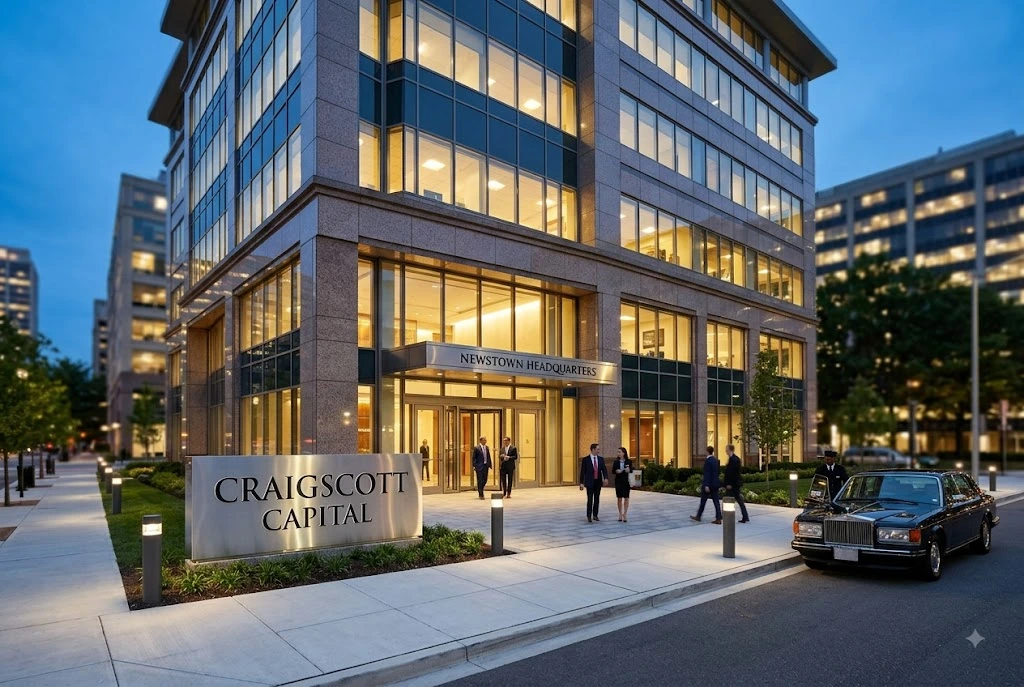
Short answer: “Newstown Craigscottcapital” is not the name of a company registered with the SEC or FINRA. It’s a search term that got attached to Craig Scott Capital, LLC, a New York brokerage that FINRA expelled in 2017. Here’s the full record and how to check any firm yourself.
If you’ve searched this term recently, you’ve probably landed on articles that read two completely different ways. Some call it a rising wealth management name worth watching in 2026. Others say it’s tied to a firm that no longer exists and was kicked out of the securities industry. Both can’t be right, so let’s sort out what’s actually documented, not just what ranks on Google.
Where the Name Comes From
There’s no firm registered with FINRA or the SEC under the name “Newstown Craigscottcapital” or “Newstown CraigScott Capital.” Check FINRA’s BrokerCheck or the SEC’s EDGAR database and the name simply doesn’t come up as an active broker-dealer or investment advisor. What does come up, using almost the same words, is Craig Scott Capital, LLC, a brokerage that operated out of Uniondale, New York, under CRD number 155924 and SEC number 8-68751.
That’s an important gap. A search term and a registered financial entity are not the same thing. Treating them as interchangeable is how people end up sending money to something that isn’t what it claims to be.
The Real Company Behind the Term
Craig Scott Capital was founded in 2010 by Craig Scott Taddonio, with Brent Morgan Porges as co-founder. It ran as a boutique brokerage, cleared trades through COR Clearing, and pitched itself on active trading strategies for individual clients. For a few years it operated like plenty of small brokerages do.
Then the regulatory record starts piling up. In 2014, the firm was censured and fined over inaccurate filings. In 2016, FINRA fined it $7,500 for submitting 95 execution and order reports that were inaccurate, incomplete, or filled out wrong. Those were the smaller problems. The bigger one came next.
The Churning Case
FINRA’s Office of Hearing Officers issued a default decision on August 10, 2017, later finalized that September. The firm was expelled from FINRA membership for three things: excessive trading of customer accounts, churning those accounts in violation of SEC Rule 10b-5, and giving false statements to FINRA investigators, which is its own separate violation under FINRA Rule 8210.
Churning, if the term is new to you, means a broker trades a customer’s account far more than makes sense for that customer’s goals, mainly to generate commissions. FINRA’s findings pointed to three registered representatives with de facto control over customer accounts, and cost-to-equity ratios and turnover rates that were excessive by any normal measure. One of those brokers, Edward Beyn, was separately barred from the industry for life. A related arbitration case, FINRA Case #2013038730901, held the firm jointly liable for compensatory and punitive damages topping $200,000 for failure to supervise, unsuitability, and unauthorized trading.
FINRA’s findings also noted that ownership was aware of red flags pointing to excessive trading and did not respond to them properly. That’s a supervision failure stacked on top of everything else.
Why “Newstown” Keeps Showing Up
Here’s the part that trips people up. A number of content sites have published near identical articles pairing “Craig Scott Capital” with different made up place names: Newstown, Financeville, Businessgrad, Cryptopia. Same basic template, different label stapled on the front. Some describe the firm in glowing terms, as if it’s an active wealth management operation with a growing client base right now. None of that matches anything in the public record. A firm expelled from FINRA membership in 2017 is not licensed to manage anyone’s money today, no matter how a blog post words it.
This is a known pattern in SEO content. A recognizable name gets reused with a new prefix, articles get written around it, and search engines start surfacing it as if it’s current news. It isn’t proof of anything except that someone wanted a keyword to rank.
How to Actually Check a Firm
Before sending money anywhere, do this instead of trusting a blog post:
- Search the exact firm name on FINRA BrokerCheck (brokercheck.finra.org). It’s free.
- Search the name and any individual advisor on the SEC’s EDGAR system and its Investment Adviser Public Disclosure database.
- Look for a CRD number and confirm the registration status is active, not expelled, revoked, or withdrawn.
- Read the disclosure section. Prior fines, arbitration awards, and expulsions are listed there in plain language.
- Call the phone number listed in the official filing, not one pulled from a random article.
None of this takes more than fifteen minutes, and it’s the difference between an informed decision and a guess.
Newstown Craigscottcapital vs. Registered Wealth Managers
A currently registered advisor or brokerage shows up on BrokerCheck or EDGAR with a clean or clearly disclosed record, an active CRD number, and a real business address you can verify on your own. “Newstown Craigscottcapital” shows up in none of those places under that name. Legitimate firms also don’t need a network of near duplicate articles across unrelated blogs to prove they exist; their registration does that job already. When a name only appears in marketing style content and nowhere in a regulatory database, that gap matters more than any track record described in a blog post.
Common Mistakes People Make
The biggest one is confusing search visibility with legitimacy. A firm can sit on page one of Google and still not be registered anywhere. The second mistake is assuming a professional sounding name means a professional grade firm behind it. The third is skipping BrokerCheck because it feels like an extra step nobody has time for.
What Happens If You Don’t Check
Investors who skipped due diligence with the actual Craig Scott Capital lost real money. FINRA’s own case record ties this firm to accounts traded aggressively enough to generate commissions beyond what the clients’ account performance could reasonably support. That’s not a hypothetical. It happened, it’s documented, and it’s exactly why the checking step exists in the first place.
FAQs
Is Newstown Craigscottcapital a real, currently active firm? No public FINRA or SEC record shows an active firm under that name.
What happened to Craig Scott Capital, LLC? FINRA expelled it from membership in 2017 over churning and false statements to regulators.
Can I still invest through Craig Scott Capital? No. An expelled firm cannot legally operate as a broker-dealer.
How do I check if any firm is registered? Use FINRA BrokerCheck and the SEC’s EDGAR or IAPD databases. Both are free and public.
Why does this name appear across so many blogs? It matches a pattern of SEO content reusing one name with different prefixes, not verified business news.
Bottom Line
“Newstown Craigscottcapital” traces back to a real brokerage that no longer has the right to operate, not a new firm worth trusting with your money. The public record on Craig Scott Capital, LLC is detailed, and none of it points to a comeback. Before acting on any article using this name, check BrokerCheck yourself. It takes less time than reading the article did.