
Life Style
Parapatric Speciation: When New Species Form Right Next Door

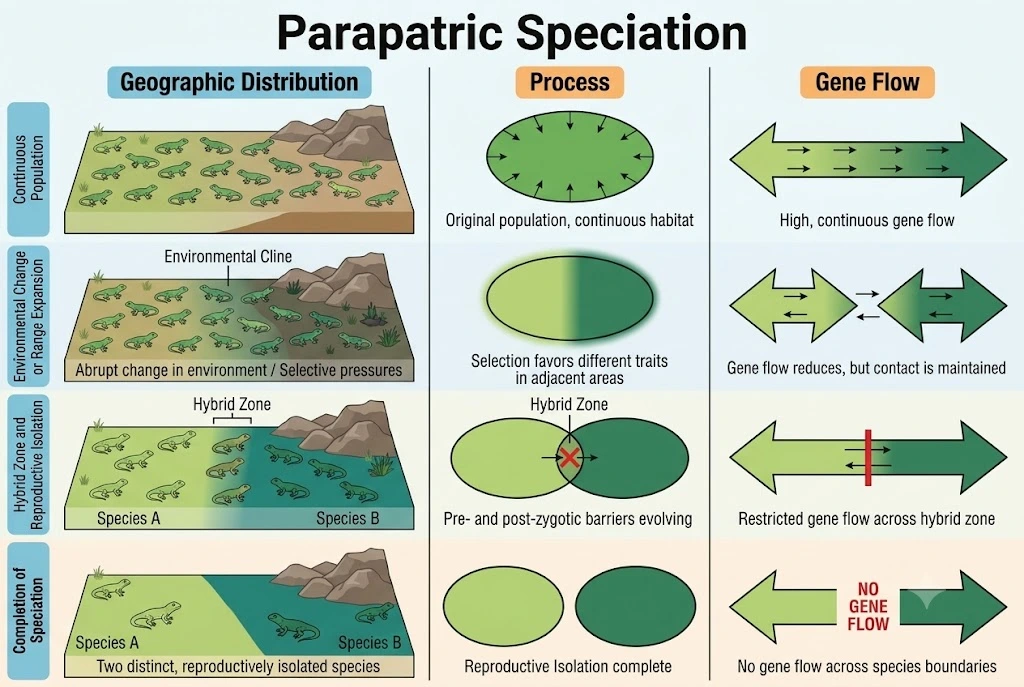
Parapatric speciation happens when new species evolve from neighboring populations that still exchange genes. Learn how this works, see real examples like metal-tolerant grasses, and understand why it matters for evolution and conservation.
Table of Contents
What Actually Is Parapatric Speciation?
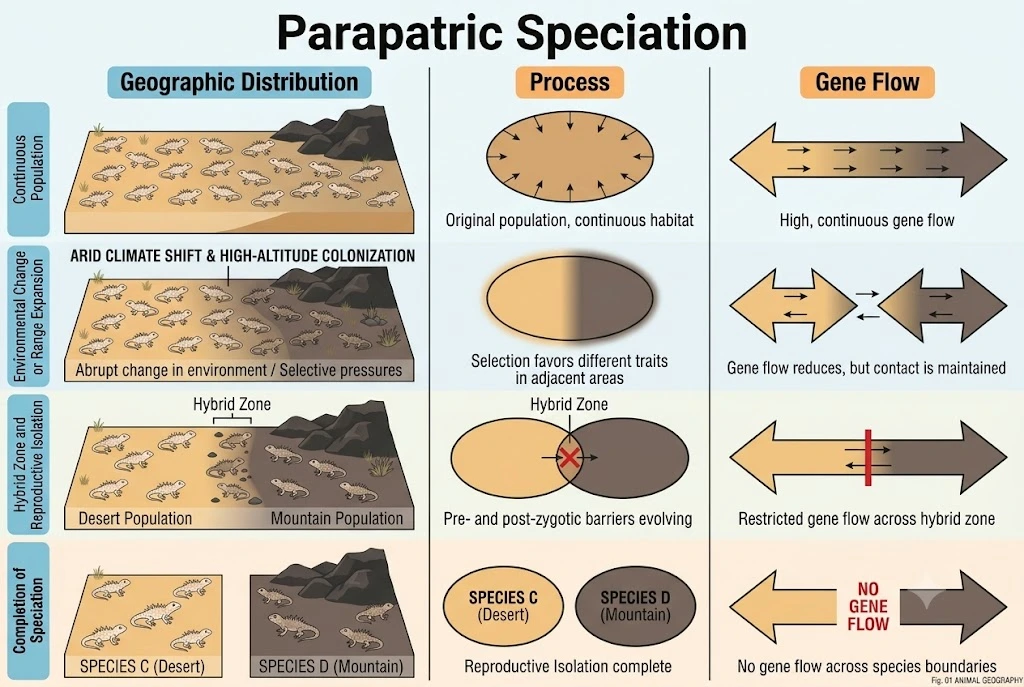
The word comes from Greek—”para” means near and “patria” means country or homeland. So parapatric speciation is about populations that live near each other, not separated by a mountain range or an ocean, and yet they still end up becoming different species.
Here’s the basic setup. You have a continuous population of organisms spread across a landscape. But that landscape isn’t uniform. Maybe the soil changes from one area to the next. Maybe the temperature shifts gradually. Maybe there’s a pollution gradient from an old mine. Whatever the reason, different parts of the range favor different traits.
The key thing about parapatric speciation is that there’s no complete physical barrier between the populations. They can still encounter each other. They can still mate, at least in theory. Gene flow—the exchange of genetic material—keeps happening.
So how does a new species emerge if individuals can still interbreed?
That’s the interesting part. And honestly, it’s also the part that makes parapatric speciation harder to study and harder to prove than other modes of speciation.
The Mechanics: How Selection Beats Gene Flow
Gene flow is like a mixing force. It tends to homogenize populations. If individuals from one area keep mating with individuals from another area, their genes get mixed together and differences get erased.
For parapatric speciation to work, natural selection has to be strong enough to overcome that mixing.
Think about it this way. Imagine a plant species that grows across a region where some areas have normal soil and other areas have soil contaminated with heavy metals from mining waste. On the normal soil, plants that can tolerate heavy metals don’t have any advantage. In fact, that tolerance might even cost them something—maybe it takes extra energy. So on normal soil, the non-tolerant plants do better.
But on the contaminated soil, it’s the opposite. Non-tolerant plants die. Only the tolerant ones survive.
Now, these two groups are growing close to each other. Pollen can blow from one group to the other. So gene flow is happening. But here’s the thing: when a tolerant plant mates with a non-tolerant plant, the offspring end up being not well adapted to either soil type. They’re mediocre everywhere. So natural selection eliminates them.
Over time, this creates a situation where the two groups become more and more distinct. They might even evolve differences in when they flower, which further reduces the chance of interbreeding.
That’s parapatric speciation in action.
Real-World Examples
The Grass That Conquered Mine Tailings
This is the classic example. It’s been studied for decades.
There’s a grass species called Agrostis tenuis that grows in England and Wales. Some populations grow on normal soils. Others grow on old mine tailings that are contaminated with lead, copper, and zinc.
The mine populations have evolved tolerance to those heavy metals. It’s a heritable trait—meaning it gets passed down genetically. The non-mine populations don’t have that tolerance.
Here’s what makes this a textbook case of parapatric speciation. The two types of populations are close enough that pollen can travel between them. Gene flow is possible. But the hybrids—the offspring of tolerant and non-tolerant plants—don’t do well on either soil type. So they get weeded out.
On top of that, the mine populations have evolved a tendency toward self-pollination rather than cross-pollination. That’s a reproductive barrier that’s starting to form. The two groups are on their way to becoming separate species.
The Greenish Warbler: A Ring Around Tibet
This one is more complex and honestly more beautiful.
The greenish warbler (Phylloscopus trochiloides) is a bird species that has formed what biologists call a “ring species” around the Tibetan Plateau.
Here’s the pattern. The warblers are distributed continuously around the plateau. As you move along this ring, neighboring populations can interbreed with each other. They’re connected by a chain of intergrading populations where traits change gradually.
But here’s the kicker. At the two ends of the ring—in central Siberia—the populations meet and they do not interbreed. They’re reproductively isolated. They act as separate species.
So what happened? The population expanded northward on two sides of the Tibetan Plateau. Over time, as they moved, the populations on each side accumulated different genetic changes. The songs males use to attract females diverged. By the time the two fronts met again at the northern end of the ring, they had become so different that they no longer recognized each other as potential mates.
Ring species like this are sometimes thought of as geographically extended parapatric speciation. They show how speciation can happen without any single point of complete isolation.
Stickleback Fish in Lakes and Streams
Threespine stickleback fish provide another clear example. In multiple lake systems in Switzerland, there are parapatric lake and stream ecotypes.
The lake fish and stream fish live in adjacent habitats. They can still encounter each other. But they’re adapted to different conditions. Lake fish are adapted to open water. Stream fish are adapted to flowing water with different food sources.
There’s a steep hybrid zone where the two habitats meet. Hybrids between the two ecotypes are less fit. The selection against hybrids maintains the boundary between the two forms.
What’s interesting is that these lake-stream pairs have evolved independently in multiple different locations. That suggests the process is repeatable. Given similar ecological gradients, parapatric speciation can happen again and again.
Arabidopsis Plants and Climate Change
More recent research has identified parapatric speciation in a plant called Arabidopsis arenicola.
After the last ice age, this plant expanded its range northward into Arctic and subarctic Canada and Greenland. As it expanded, it underwent a shift in its mating system—it started self-fertilizing more.
The parental species stayed in temperate North America. The new, expanded population became different enough that it’s now considered a separate species. And this happened without full geographic isolation.
This is a nice example because it shows parapatric speciation happening in response to climate change and range expansion. It’s not just an abstract concept from textbooks. It’s something that has occurred relatively recently in evolutionary time.
Other Examples Worth Mentioning
- Ensatina salamanders in California form another ring species around the Central Valley. Different populations around the ring can interbreed with their neighbors, but the terminal populations don’t interbreed.
- Bullock’s orioles and Baltimore orioles hybridize where their territories meet in the central United States. One is a western bird, the other an eastern bird. They meet, they hybridize, but they remain distinct.
- Cichlid fish in Lake Victoria have evolved different opsin genes to see at different water depths. This is thought to be an example of parapatric divergence driven by differences in light availability at different depths.
How Parapatric Compares to Other Modes
This is worth getting straight because people mix these up.
Allopatric speciation happens when populations are completely geographically separated. A mountain range rises. A river changes course. A population gets split. There’s no gene flow at all because there’s no contact. This is the simplest and probably the most common mode of speciation.
Sympatric speciation happens when populations diverge while living in the same geographic area. There’s no geographic separation at all. This is the hardest mode to explain and the hardest to prove. It requires strong disruptive selection or other mechanisms to overcome gene flow.
Parapatric speciation sits in between. Populations are partially separated. They overlap in part of their ranges but not all. Gene flow is reduced but not eliminated.
The gene flow rate is higher in parapatric speciation than in allopatric speciation, but lower than in sympatric speciation. So parapatric is the intermediate case.
Common Misconceptions and Mistakes
One common mistake is thinking parapatric speciation requires a sharp environmental boundary. It doesn’t. The environmental gradient can be gradual. Over many generations, even a small selective advantage can accumulate and lead to divergence.
Another mistake is assuming that any two populations that look different and live next to each other are an example of parapatric speciation. They might be. But they might also be cases where populations diverged in allopatry (complete isolation) and then came back into contact later. That’s called secondary contact, and it can look similar to parapatric speciation.
This is one reason parapatric speciation is hard to verify. You need historical data on what the populations’ ranges looked like during the divergence process. That kind of data is often unavailable.
A third mistake is thinking gene flow has to stop completely for speciation to happen. In parapatric speciation, it doesn’t. Gene flow can continue during the divergence process. It just has to be low enough that selection can overcome it.
What Happens If You Get It Wrong
This might sound academic, but there are practical consequences.
In conservation, if you misclassify a parapatric population as a separate species when it’s not, you might allocate resources to protecting something that doesn’t need it. Or worse, you might fail to protect something that does need it because you didn’t recognize it as distinct.
In agriculture, understanding parapatric speciation matters for managing pests and weeds. The grass examples I mentioned earlier are relevant here. If you have a weed population that’s evolving tolerance to something—herbicides, for instance—understanding how that tolerance spreads and whether it’s leading to reproductive isolation can inform management decisions.
In public health, similar principles apply to pathogens and disease vectors. If populations of a mosquito species are diverging parapatrically, that might affect how diseases spread and how you control them.
Why Parapatric Speciation Matters
Here’s the thing. Allopatric speciation is the clean, easy story. A barrier appears. Populations separate. They diverge. New species form. It’s the textbook version.
But the real world is messier than textbooks. Barriers aren’t always absolute. Populations don’t always get completely separated. Gene flow often continues.
Parapatric speciation shows us that speciation can happen even when populations remain in contact. It shows that natural selection can be powerful enough to overcome the homogenizing effects of gene flow.
This matters for understanding biodiversity. If speciation only happened in allopatry, we’d expect to see new species only where there are geographic barriers. But we see new species forming in all kinds of contexts—along environmental gradients, across habitat transitions, around geographic barriers like the Tibetan Plateau.
Parapatric speciation also matters for understanding how fast evolution can happen. Allopatric speciation can take a long time—populations need to be separated for many generations. Parapatric speciation can potentially happen faster because it doesn’t require a physical barrier to appear first.
And it matters for understanding how species will respond to environmental change. As climates shift and habitats change, populations will need to adapt or move. Parapatric speciation might be one way that new species arise in response to these changes, without populations having to be completely isolated from each other.
The Bottom Line
Parapatric speciation is speciation with gene flow. Populations that are adjacent to each other, not separated by a barrier, diverge because different conditions in different parts of their range favor different traits. Selection is strong enough to overcome the mixing effect of gene flow.
It’s harder to study than allopatric speciation. It’s harder to prove. But it’s real, and it’s probably more common than we used to think.
The grass on mine tailings. The warblers around Tibet. The stickleback in lakes and streams. The Arabidopsis expanding after the ice age. These aren’t just textbook examples. They’re real cases where we can see the process happening.
And they show us something important about how evolution works. You don’t always need a barrier. Sometimes, just living next door to each other is enough.
FAQs
Q: What’s the main difference between parapatric and allopatric speciation?
A: Allopatric speciation requires complete geographic separation with no gene flow. Parapatric speciation happens between neighboring populations that still exchange genes.
Q: Can parapatric speciation happen without any physical barrier?
A: Yes. That’s exactly what defines it. The separation is ecological, not physical—different conditions in different parts of the range create different selective pressures.
Q: Why is parapatric speciation harder to prove than allopatric?
A: Because you need historical data on past ranges to confirm that populations diverged while in contact, rather than diverging in isolation and later coming back into contact.
Q: What’s a ring species?
A: A ring species is a special case of parapatric speciation where populations form a ring around a geographic barrier. Neighboring populations interbreed, but the populations at the ends of the ring don’t.
Q: Is parapatric speciation common?
A: It may be common, but it’s difficult to verify. Some researchers think it’s probably more widespread than the literature suggests, but proving it requires detailed historical and genetic data.
Conclusion
Parapatric speciation is the middle child of speciation modes. It’s not as clean as allopatric speciation. It’s not as controversial as sympatric speciation. But it might be the one that best represents how evolution actually works in many real-world situations.
Populations don’t always get neatly separated by barriers. They often exist along gradients, with different conditions at different points. And when those conditions are different enough, and selection is strong enough, new species can emerge even while gene flow continues.
The examples are concrete. The grass on mine tailings that evolved metal tolerance. The warblers that circled the Tibetan Plateau and became different species at the ends of the ring. The stickleback that adapted to lakes versus streams.
These aren’t abstract concepts. They’re real biological processes that have been observed and studied. And they matter—for understanding biodiversity, for conservation, for agriculture, and for understanding how life responds to a changing world.